Master IB Exness High Level Briliant - 90% Rebate Exness automatic transfer to account trading every day!!

Algeria, Angola, Antigua and Barbuda, Argentina, Armenia, Aruba, Azerbaijan, Bahrain, Bangladesh, Belize, Benin, Bhutan, Bolivia, Botswana, Brazil, Brunei, Burkina Faso, Burundi, Cambodia, Cameroon, Cape Verde, Chad, Chile, China, Colombia, Comoros, Costa Rica, Djibouti, Dominica, Dominican Republic, East Timor, Ecuador, Egypt, El Salvador, Equatorial Guinea, Eritrea, Ethiopia, Gabon, Gambia, Georgia, Ghana, Grenada, Guatemala, Guernsey, Guinea, GuineaBissau, Guyana, Honduras, Hong Kong, India, Indonesia, Isle of Man, Jamaica, Japan, Jersey, Jordan, Kazakhstan, Kenya, Kuwait, Kyrgyzstan, Laos, Lebanon, Lesotho, Liberia, Libya, Macau, Madagascar, Malawi, Maldives, Mauritania, Mexico, Moldova, Mongolia, Montenegro, Montserrat, Morocco, Mozambique, Namibia, Nauru, Nepal, Niger, Nigeria, Oman, Pakistan, Panama, Papua New Guinea, Paraguay, Peru, Philippines, Qatar, Republic of the Congo, Rwanda, Saint Kitts and Nevis, Saint Lucia, Sao Tome and Principe, Saudi Arabia, Senegal, Serbia, Sierra Leone, Solomon Islands, South Africa, Sri Lanka, Suriname, Swaziland, Taiwan, Tajikistan, Tanzania, Thailand, Togo, Tonga, Trinidad and Tobago, Tunisia, Turkey, Turkmenistan, Uganda, United Arab Emirates, Uzbekistan, Venezuela, Vietnam, Zambia, Zimbabwe

Welcome to 90% Rebate Exness

www.rebateness.com is a Exness IB with Intoducing Brokers code: :
https://one.exnessonelink.com/a/rebate90
( Open Exness Account with IB code: rebate90 )
https://www.rebateness.com is a trusted Exness IB with return of trader spread the biggest in the world, which is 90% rebate.
Your 90% rebate will be sent automatically to your account every Day.
Web Login Exness Register Exness Rebates List Pair Commision 90%

What is the Head and Shoulders Pattern: Definition, Characteristics, and Structure

The Head and Shoulders pattern is one of the most well-known reversal patterns in technical analysis. Traders often use this pattern to identify potential shifts in market direction from bullish (uptrend) to bearish (downtrend). In this article, we'll delve into the details of this pattern, its characteristics, and how to interpret it.

Definition of the Head and Shoulders Pattern

The Head and Shoulders pattern is a reversal pattern that signals a change from an uptrend (bullish) to a downtrend (bearish). This pattern is recognized as a major reversal pattern due to its significance and accuracy in identifying market turning points. It can appear across various time frames, making it versatile for both short-term (day trading) and long-term (swing trading) strategies.

Structure and Components of the Head and Shoulders Pattern

The Head and Shoulders pattern consists of four main parts:

  1. Left Shoulder: This forms after a strong bullish trend. The price rises to form a peak and then falls to create a trough.

  2. Head: The price rises again to form a higher peak than the left shoulder before falling back to the trough level between the left shoulder and the head.

  3. Right Shoulder: After forming the head, the price rises once more but only to a lower peak than the head before falling again. The right shoulder usually resembles the left shoulder in shape but may not be identical.

  4. Neckline: This is the line connecting the lowest points of the troughs between the left and right shoulders. The neckline can be horizontal, sloping upward, or sloping downward.

Formation Process of the Pattern

  • Left Shoulder: Forms after an uptrend, where the price reaches a peak and then drops to a trough.
  • Head: The price rises again to a higher peak and then falls to form a trough below the level of the left shoulder.
  • Right Shoulder: The price rises again to form a peak lower than the head before falling again.
  • Breakout: The pattern is considered complete, and the reversal signal is confirmed when the price breaks below the neckline after the right shoulder is formed.

Variations of the Head and Shoulders Pattern

The Head and Shoulders pattern can have variations, such as:

  • Standard Head and Shoulders: A pattern where the left and right shoulders have similar shapes and sizes, with a horizontal or sloping neckline.
  • Inverted Head and Shoulders: This is the reverse of the standard pattern and indicates a reversal from a downtrend to an uptrend.

The Role of Volume in the Head and Shoulders Pattern

Volume is an important additional indicator for confirming the Head and Shoulders pattern:

  1. Volume in the Left Shoulder: Typically high, reflecting strong buying interest as the peak forms.
  2. Volume in the Head: Tends to be lower than in the left shoulder, indicating a decline in buying interest.
  3. Volume in the Right Shoulder: Usually the lowest, showing reduced buying interest before a further decline.
  4. Volume During Breakout: Volume significantly increases when the price breaks below the neckline.
  5. Volume During Pullback: Volume decreases during a pullback (temporary upward movement), if one occurs.
  6. Volume After Pullback: Volume increases again as the market resumes the downtrend after the pullback.

The Head and Shoulders pattern is a highly useful tool in technical analysis for identifying potential market direction changes. While this pattern often provides accurate signals, it's important to remember that no pattern is perfect. Always use additional indicators and volume confirmation to reinforce your trading decisions. With a deep understanding and proper application, this pattern can help you make better trading decisions.

Share:

Understanding the Marubozu Candle and Strategies for Trading

Candlestick patterns are a crucial tool in technical analysis, and one of the most basic and easily recognizable patterns is the Marubozu. The name "Marubozu" comes from Japanese, meaning "bald head," referring to a candlestick that has no wicks, resembling a solid block without shadows.

What Is a Marubozu Candlestick?

A Marubozu candlestick is a pattern that lacks upper and lower shadows. This means that the opening price (open) is the same as the lowest price (for a bullish Marubozu) or the highest price (for a bearish Marubozu), and the closing price (close) is the same as the highest (bullish) or lowest price (bearish). This pattern indicates that buyers or sellers have controlled the market throughout the session, with no significant opposition from the other side.

Bullish and Bearish Marubozu Candles

The Marubozu pattern can indicate the strength of an ongoing trend, whether bullish or bearish:

  • Bullish Marubozu Candle: The price opens at the lowest point and closes at the highest. This suggests that buyers dominated the market, pushing the price upward continuously throughout the session.

  • Bearish Marubozu Candle: The price opens at the highest point and closes at the lowest. This indicates that sellers controlled the market, driving the price down without interruption during the session.

Types of Marubozu Candles

There are three types of Marubozu candles that traders should be aware of:

  1. Full Marubozu: This type has no shadows at all, either at the top or bottom, indicating full dominance by buyers (bullish) or sellers (bearish) throughout the session.

  2. Open Marubozu: This candle has a shadow at the close, but none at the open. It shows that the price moved in one direction from the start of the session, whether up or down.

  3. Close Marubozu: This candle has a shadow at the open but none at the close. It indicates that the price temporarily moved in the opposite direction during the session but returned to the dominant direction by the close.

How to Use Marubozu Candles in Trading

Marubozu candles are rare, but when they appear, they indicate significant strength in the price movement. A bullish Marubozu pattern typically signals a continuation of an uptrend, while a bearish Marubozu can indicate a continuation of a downtrend. However, this pattern can also signal consolidation, so it's important to use it in conjunction with other indicators for confirmation.

Reading and Applying Marubozu Candles

Interpreting Marubozu candles is straightforward:

  • White Marubozu at the end of an uptrend: The trend is likely to continue.
  • White Marubozu at the end of a downtrend: A trend reversal is likely.
  • Black Marubozu at the end of a downtrend: The trend is likely to continue.
  • Black Marubozu at the end of an uptrend: A trend reversal is likely.

However, these predictions are not always accurate. Therefore, it’s essential to observe the following candlestick patterns for confirmation and use other indicators like triangle or rectangle chart patterns or Fibonacci retracement. Multi-time frame analysis can also help overcome the limitations of the Marubozu pattern.

The Marubozu candle is a powerful candlestick pattern that can provide valuable insights into market trends. However, like all technical analysis tools, it should be used in combination with other indicators for more accurate results. For inexperienced traders, understanding and effectively using the Marubozu candle can be a crucial step in improving their trading strategies.

Share:

SMA vs. EMA: Which Indicator is Better for Trading?

In the trading world, the Moving Average (MA) indicator is one of the most frequently used technical analysis tools by traders. The two most popular variants of this indicator are the Simple Moving Average (SMA) and the Exponential Moving Average (EMA). Each has its own unique features and uses, but the question remains: which one is better? This article will compare SMA and EMA to help you understand when and how to use each of these indicators effectively.

Understanding Moving Averages and Their Types

Moving Average is an indicator that calculates the average price over a specific period, providing an overview of the ongoing price trend. There are several types of Moving Averages, but the two most commonly used are:

  • Simple Moving Average (SMA): The SMA calculates the average price in a straightforward manner by summing the closing prices over a certain period and then dividing by the number of periods. SMA provides a smoother view and tends to ignore short-term price fluctuations, making it suitable for beginner traders who seek stability in their analysis.

  • Exponential Moving Average (EMA): Unlike the SMA, the EMA places greater weight on more recent closing prices, making it more responsive to price changes. EMA is often used by traders who want to quickly capture trend changes, especially on lower time frames, such as during economic news releases that can trigger high market volatility.

Comparing the Use of SMA and EMA in Trading

It’s important to note that this comparison is not meant to determine which indicator is universally the best, but rather to understand when and under what conditions each indicator is more effectively used.

When is the Best Time to Use the SMA Indicator?

The SMA is slower to react to price changes due to its simple averaging calculation. The SMA line tends to move further away from the current price, making it more effective as a marker for support and resistance levels. SMA is particularly useful on longer time frames and periods where short-term price fluctuations do not significantly impact the analysis. Therefore, SMA is often used by more conservative traders who focus on long-term trading.

When is the EMA Indicator More Suitable?

Since the EMA is more responsive to price changes, it is better suited for short-term trading or scalping, where speed in capturing trend changes is crucial. The EMA will more closely follow price movements, providing quicker entry and exit signals compared to the SMA. For traders looking to capitalize on short-term price movements, the EMA is the better choice.

There is no definitive answer as to whether the Exponential Moving Average is better than the Simple Moving Average, or vice versa. Each has its own strengths and weaknesses, making them more suitable for different situations. The SMA offers stability and is better for long-term analysis, while the EMA is more responsive and ideal for short-term trading.

To maximize trading results, traders should learn to recognize market conditions and choose the indicator that best fits their trading style and strategy. Understanding and mastering both indicators will provide you with a powerful toolset to optimize your trading decisions. If you haven’t used moving averages before, there are many reliable resources available online to help you get started, especially from experienced professional traders.

Share:

Next Level of Hedging: Understanding Arbitrage in Forex

Arbitrage is a well-known strategy in trading, including in the forex market. However, it's crucial to understand that the concept of arbitrage in forex differs from legal arbitrage. In trading, arbitrage involves buying and selling the same asset in two different markets to take advantage of price differences and profit from the discrepancy. This article delves deeper into what forex arbitrage is, how it works, and the risks involved.

What is Forex Arbitrage?

Forex arbitrage is a technique where a trader, known as an arbitrageur, simultaneously buys in one market and sells in another. The goal of this strategy is to exploit the price differences between these two markets. For example, if a currency is traded at a lower price on one broker while being higher on another, an arbitrageur can buy from the cheaper broker and sell at the more expensive one to profit from the price difference.

This strategy can be executed in various ways, but the core idea is to capitalize on price anomalies that may occur due to differences in time, location, or trading platforms. Forex arbitrage is considered an efficient strategy because, under ideal conditions, profit can be made without significant risk.

Methods of Forex Arbitrage

There are several methods of arbitrage that can be used in forex trading, with two of the most common being:

  1. Broker Arbitrage: This involves using two different brokers who may offer different price quotes for the same currency pair. A trader buys the currency from the broker offering the lower price and sells it to the one offering the higher price.

  2. Triangular Arbitrage: This method involves three different currency pairs. The trader takes advantage of price differences that may occur when making simultaneous transactions on all three pairs. This strategy is somewhat similar to hedging, as it involves transactions that balance out the risk.

Risks in Forex Arbitrage

One of the myths in forex arbitrage is the belief that this strategy is risk-free. In reality, there are several risks to consider:

  1. Fast Execution: Forex arbitrage requires very quick execution to take advantage of price differences before they disappear. For institutional traders or hedge funds, this can be achieved with High-Frequency Trading (HFT) and sophisticated algorithms. However, for retail traders, executing arbitrage manually can be a significant challenge due to delays or slippage that can erase potential profits.

  2. Slippage: Rapid price changes or minor price differences (slippage) can significantly affect the profitability of an arbitrage strategy. Even a few pips of slippage can wipe out profit opportunities, especially when transaction costs are factored in.

  3. Scam Risk: Many forex trading robots claim to use arbitrage techniques to generate profits. However, caution is advised, as some of these might be scams. It is essential to perform due diligence on any trading robot you intend to use, including verifying whether your broker allows the arbitrage techniques employed by the robot.

  4. Broker Restrictions: Not all forex brokers permit the use of arbitrage strategies, especially Broker Arbitrage. Before employing this technique, ensure you read your broker's terms and conditions to avoid violating rules that could lead to profit cancellation or even account closure.

Forex arbitrage is an intriguing strategy for many traders due to the potential profits that can be made from price differences across various markets. However, this strategy is not without risks, especially for retail traders. Fast execution and the risk of slippage are significant challenges that must be overcome. If you're interested in trying arbitrage, make sure to fully understand the methods used, the associated risks, and whether your broker permits the strategy. With the proper understanding, arbitrage can become part of a broader trading strategy and help you maximize profit potential in forex trading.

Share:

Understanding the Inverted Head and Shoulders Pattern: Definition, Characteristics, and How to Utilize It

The Inverted Head and Shoulders pattern is one of the most recognized patterns in technical analysis, especially within the Reversal Chart Pattern category. This pattern is considered the opposite of the standard Head and Shoulders pattern and is often relied upon by traders to identify potential trend reversals from bearish (downtrend) to bullish (uptrend). Although this pattern does not appear frequently, its reliability makes it an essential tool in trading strategies.

What is the Inverted Head and Shoulders Pattern?

Simply put, the Inverted Head and Shoulders pattern is a formation that indicates a reversal from a downtrend to an uptrend. Its appearance suggests that selling pressure has reached its lowest point, and the market is beginning to reverse upward. This is a strong signal for traders that the bearish trend has ended and a new bullish trend is about to begin.

Key Features of the Inverted Head and Shoulders Pattern

The Inverted Head and Shoulders pattern consists of three main components: two shoulders and one head. Below is a detailed explanation of its features:

  1. Left Shoulder: Forms when the price declines to a certain low point and then rises again, creating the left shoulder.
  2. Head: After the left shoulder, the price falls further than the first decline, creating the lowest point known as the head.
  3. Right Shoulder: After forming the head, the price rises again but then declines, though not as low as the head, forming the right shoulder.

Once these three elements are formed, the Inverted Head and Shoulders pattern is considered complete when the price breaks through the neckline, which is the line connecting the peaks of both shoulders.

Principles of the Inverted Head and Shoulders Pattern

The basic principle behind this pattern is a price decline to a point where the market cannot sustain lower prices, followed by a price recovery. This pattern reflects a psychological shift in the market, where selling interest starts to weaken, and buying pressure increases.

  • Right Shoulder: Indicates that the price can no longer fall lower and may even move higher than the head, showing that selling pressure is diminishing.
  • Breakout Point: When the price successfully breaks through the neckline, it becomes a strong signal that the trend has reversed to bullish.

Trading Strategies with the Inverted Head and Shoulders Pattern

The Inverted Head and Shoulders pattern offers several trading opportunities:

  1. Buying (Entry): You can enter a buy position when the price breaks through the neckline by placing a buy order slightly above the breakout point.
  2. Selling (Stop-Loss): If the price declines again and breaks through the support level at the right shoulder or head, you may consider closing the position or setting a stop-loss.
  3. Profit-Taking: The profit target is usually set at a distance equal to the distance between the head and the neckline, measured from the breakout point.

The Inverted Head and Shoulders pattern is one of the most reliable reversal patterns in technical analysis. Although it is rare, when it forms, it provides a strong signal of potential trend reversal. Mastering this pattern and utilizing it in your trading strategy can help you identify profitable entry opportunities in volatile market conditions. In the next article, we will further discuss the role of volume in confirming this pattern and how to use it to enhance your trading accuracy.

Share:

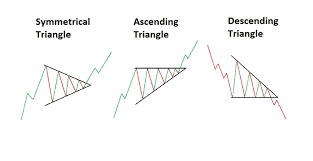
Understanding Triangle Patterns in Technical Trading Analysis

In the world of trading, understanding technical patterns can be a key to success. One of the patterns frequently used by traders is the Triangle Pattern. This article will delve into the importance of the Triangle Pattern in trading, its various types, and the potential impact when such a pattern forms. We will discuss the three main types of Triangle Patterns: Symmetrical Triangle, Ascending Triangle, and Descending Triangle. Additionally, we will explore how to ensure the validity of these patterns.

  1. Symmetrical Triangle

    • The Symmetrical Triangle is a pattern where the resistance line (connecting the peaks of price) and the support line (connecting the price troughs) converge at a single point. This pattern usually appears when there is balanced pressure between buyers and sellers, causing the price to move within a narrowing range. This phenomenon reflects a consolidation phase in the market, where buying and selling forces are in equilibrium.
    • The main impact of a Symmetrical Triangle is the potential for a significant breakout, either upwards or downwards. This pattern is often considered a continuation pattern, meaning that the price tends to continue its previous trend after a breakout occurs. As a trader, it is crucial to monitor trading volume during the formation of this pattern, as an increase in volume typically confirms the potential for a breakout.
  2. Ascending Triangle

    • The Ascending Triangle forms when there is a horizontal resistance line at the top and an upward-sloping support line at the bottom, overall forming a triangle. This pattern indicates that buying pressure is increasing, while the price is held at a certain resistance level. If the price manages to break through this resistance level, the pattern is considered a bullish signal, with the price likely to move higher.
    • The Ascending Triangle is also part of the continuation pattern group, indicating that the price is likely to continue its prior uptrend. Traders often use this pattern as a signal to enter a buy position, especially when the resistance breakout occurs with high volume.
  3. Descending Triangle

    • The Descending Triangle is the opposite of the Ascending Triangle. In this pattern, a horizontal support line forms at the bottom, while the resistance line slopes downward, reflecting increasing selling pressure. This pattern indicates that sellers are beginning to dominate the market, and there is a possibility that the price will break through the support level.
    • Like the Ascending Triangle, the Descending Triangle is also categorized as a continuation pattern. When the price breaks the support level with high volume, it can signal an entry point for a sell position, as the price is likely to continue its previous downtrend.

Ensuring the Validity of Triangle Patterns

To ensure that a Triangle Pattern is valid, consider the following:

  1. Volume: A valid pattern is often followed by an increase in volume at the time of the breakout.
  2. Formation Duration: The longer it takes for the pattern to form, the stronger the signal it typically generates.
  3. Confirmation: A breakout should ideally be confirmed by a candle closing outside the support or resistance line.

Mastering these three types of Triangle Patterns is crucial to enhancing your potential profits in trading. By understanding the characteristics of each pattern and how to confirm their validity, you can make smarter trading decisions and maximize your portfolio. Always remember to keep learning and stay motivated in your trading journey!

Share:
 Algeria ● Angola ● Antigua and Barbuda ● Argentina ● Armenia ● Aruba ● Azerbaijan ● Bahrain ● Bangladesh ● Belize ● Benin ● Bhutan ● Bolivia ● Botswana ● Brazil ● Brunei ● Burkina Faso ● Burundi ● Cambodia ● Cameroon ● Cape Verde ● Chad ● Chile ● China ● Colombia ● Comoros ● Costa Rica ● Djibouti ● Dominica ● Dominican Republic ● East Timor ● Ecuador ● Egypt ● El Salvador ● Equatorial Guinea ● Eritrea ● Ethiopia ● Gabon ● Gambia ● Georgia ● Ghana ● Grenada ● Guatemala ● Guernsey ● Guinea ● GuineaBissau ● Guyana ● Honduras ● Hong Kong ● India ● Indonesia ● Isle of Man ● Jamaica ● Japan ● Jersey ● Jordan ● Kazakhstan ● Kenya ● Kuwait ● Kyrgyzstan ● Laos ● Lebanon ● Lesotho ● Liberia ● Libya ● Macau ● Madagascar ● Malawi ● Maldives ● Mauritania ● Mexico ● Moldova ● Mongolia ● Montenegro ● Montserrat ● Morocco ● Mozambique ● Namibia ● Nauru ● Nepal ● Niger ● Nigeria ● Oman ● Pakistan ● Panama ● Papua New Guinea ● Paraguay ● Peru ● Philippines ● Qatar ● Republic of the Congo ● Rwanda ● Saint Kitts and Nevis ● Saint Lucia ● Sao Tome and Principe ● Saudi Arabia ● Senegal ● Serbia ● Sierra Leone ● Solomon Islands ● South Africa ● Sri Lanka ● Suriname ● Swaziland ● Taiwan ● Tajikistan ● Tanzania ● Thailand ● Togo ● Tonga ● Trinidad and Tobago ● Tunisia ● Turkey ● Turkmenistan ● Uganda ● United Arab Emirates ● Uzbekistan ● Venezuela ● Vietnam ● Zambia ● Zimbabwe