Master IB Exness High Level Briliant - 90% Rebate Exness automatic transfer to account trading every day!!

Algeria, Angola, Antigua and Barbuda, Argentina, Armenia, Aruba, Azerbaijan, Bahrain, Bangladesh, Belize, Benin, Bhutan, Bolivia, Botswana, Brazil, Brunei, Burkina Faso, Burundi, Cambodia, Cameroon, Cape Verde, Chad, Chile, China, Colombia, Comoros, Costa Rica, Djibouti, Dominica, Dominican Republic, East Timor, Ecuador, Egypt, El Salvador, Equatorial Guinea, Eritrea, Ethiopia, Gabon, Gambia, Georgia, Ghana, Grenada, Guatemala, Guernsey, Guinea, GuineaBissau, Guyana, Honduras, Hong Kong, India, Indonesia, Isle of Man, Jamaica, Japan, Jersey, Jordan, Kazakhstan, Kenya, Kuwait, Kyrgyzstan, Laos, Lebanon, Lesotho, Liberia, Libya, Macau, Madagascar, Malawi, Maldives, Mauritania, Mexico, Moldova, Mongolia, Montenegro, Montserrat, Morocco, Mozambique, Namibia, Nauru, Nepal, Niger, Nigeria, Oman, Pakistan, Panama, Papua New Guinea, Paraguay, Peru, Philippines, Qatar, Republic of the Congo, Rwanda, Saint Kitts and Nevis, Saint Lucia, Sao Tome and Principe, Saudi Arabia, Senegal, Serbia, Sierra Leone, Solomon Islands, South Africa, Sri Lanka, Suriname, Swaziland, Taiwan, Tajikistan, Tanzania, Thailand, Togo, Tonga, Trinidad and Tobago, Tunisia, Turkey, Turkmenistan, Uganda, United Arab Emirates, Uzbekistan, Venezuela, Vietnam, Zambia, Zimbabwe

Welcome to 90% Rebate Exness

www.rebateness.com is a Exness IB with Intoducing Brokers code: :
https://one.exnessonelink.com/a/rebate90
( Open Exness Account with IB code: rebate90 )
https://www.rebateness.com is a trusted Exness IB with return of trader spread the biggest in the world, which is 90% rebate.
Your 90% rebate will be sent automatically to your account every Day.
Web Login Exness Register Exness Rebates List Pair Commision 90%

Understanding the Inverted Head and Shoulders Pattern: Definition, Characteristics, and How to Utilize It

The Inverted Head and Shoulders pattern is one of the most recognized patterns in technical analysis, especially within the Reversal Chart Pattern category. This pattern is considered the opposite of the standard Head and Shoulders pattern and is often relied upon by traders to identify potential trend reversals from bearish (downtrend) to bullish (uptrend). Although this pattern does not appear frequently, its reliability makes it an essential tool in trading strategies.

What is the Inverted Head and Shoulders Pattern?

Simply put, the Inverted Head and Shoulders pattern is a formation that indicates a reversal from a downtrend to an uptrend. Its appearance suggests that selling pressure has reached its lowest point, and the market is beginning to reverse upward. This is a strong signal for traders that the bearish trend has ended and a new bullish trend is about to begin.

Key Features of the Inverted Head and Shoulders Pattern

The Inverted Head and Shoulders pattern consists of three main components: two shoulders and one head. Below is a detailed explanation of its features:

  1. Left Shoulder: Forms when the price declines to a certain low point and then rises again, creating the left shoulder.
  2. Head: After the left shoulder, the price falls further than the first decline, creating the lowest point known as the head.
  3. Right Shoulder: After forming the head, the price rises again but then declines, though not as low as the head, forming the right shoulder.

Once these three elements are formed, the Inverted Head and Shoulders pattern is considered complete when the price breaks through the neckline, which is the line connecting the peaks of both shoulders.

Principles of the Inverted Head and Shoulders Pattern

The basic principle behind this pattern is a price decline to a point where the market cannot sustain lower prices, followed by a price recovery. This pattern reflects a psychological shift in the market, where selling interest starts to weaken, and buying pressure increases.

  • Right Shoulder: Indicates that the price can no longer fall lower and may even move higher than the head, showing that selling pressure is diminishing.
  • Breakout Point: When the price successfully breaks through the neckline, it becomes a strong signal that the trend has reversed to bullish.

Trading Strategies with the Inverted Head and Shoulders Pattern

The Inverted Head and Shoulders pattern offers several trading opportunities:

  1. Buying (Entry): You can enter a buy position when the price breaks through the neckline by placing a buy order slightly above the breakout point.
  2. Selling (Stop-Loss): If the price declines again and breaks through the support level at the right shoulder or head, you may consider closing the position or setting a stop-loss.
  3. Profit-Taking: The profit target is usually set at a distance equal to the distance between the head and the neckline, measured from the breakout point.

The Inverted Head and Shoulders pattern is one of the most reliable reversal patterns in technical analysis. Although it is rare, when it forms, it provides a strong signal of potential trend reversal. Mastering this pattern and utilizing it in your trading strategy can help you identify profitable entry opportunities in volatile market conditions. In the next article, we will further discuss the role of volume in confirming this pattern and how to use it to enhance your trading accuracy.
Share:

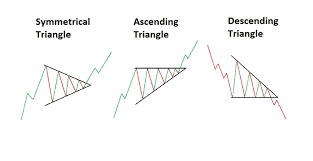
Understanding Triangle Patterns in Technical Trading Analysis

In the world of trading, understanding technical patterns can be a key to success. One of the patterns frequently used by traders is the Triangle Pattern. This article will delve into the importance of the Triangle Pattern in trading, its various types, and the potential impact when such a pattern forms. We will discuss the three main types of Triangle Patterns: Symmetrical Triangle, Ascending Triangle, and Descending Triangle. Additionally, we will explore how to ensure the validity of these patterns.

  1. Symmetrical Triangle

    • The Symmetrical Triangle is a pattern where the resistance line (connecting the peaks of price) and the support line (connecting the price troughs) converge at a single point. This pattern usually appears when there is balanced pressure between buyers and sellers, causing the price to move within a narrowing range. This phenomenon reflects a consolidation phase in the market, where buying and selling forces are in equilibrium.
    • The main impact of a Symmetrical Triangle is the potential for a significant breakout, either upwards or downwards. This pattern is often considered a continuation pattern, meaning that the price tends to continue its previous trend after a breakout occurs. As a trader, it is crucial to monitor trading volume during the formation of this pattern, as an increase in volume typically confirms the potential for a breakout.
  2. Ascending Triangle

    • The Ascending Triangle forms when there is a horizontal resistance line at the top and an upward-sloping support line at the bottom, overall forming a triangle. This pattern indicates that buying pressure is increasing, while the price is held at a certain resistance level. If the price manages to break through this resistance level, the pattern is considered a bullish signal, with the price likely to move higher.
    • The Ascending Triangle is also part of the continuation pattern group, indicating that the price is likely to continue its prior uptrend. Traders often use this pattern as a signal to enter a buy position, especially when the resistance breakout occurs with high volume.
  3. Descending Triangle

    • The Descending Triangle is the opposite of the Ascending Triangle. In this pattern, a horizontal support line forms at the bottom, while the resistance line slopes downward, reflecting increasing selling pressure. This pattern indicates that sellers are beginning to dominate the market, and there is a possibility that the price will break through the support level.
    • Like the Ascending Triangle, the Descending Triangle is also categorized as a continuation pattern. When the price breaks the support level with high volume, it can signal an entry point for a sell position, as the price is likely to continue its previous downtrend.

Ensuring the Validity of Triangle Patterns

To ensure that a Triangle Pattern is valid, consider the following:

  1. Volume: A valid pattern is often followed by an increase in volume at the time of the breakout.
  2. Formation Duration: The longer it takes for the pattern to form, the stronger the signal it typically generates.
  3. Confirmation: A breakout should ideally be confirmed by a candle closing outside the support or resistance line.

Mastering these three types of Triangle Patterns is crucial to enhancing your potential profits in trading. By understanding the characteristics of each pattern and how to confirm their validity, you can make smarter trading decisions and maximize your portfolio. Always remember to keep learning and stay motivated in your trading journey!

Share:

Understanding Emerging Market Currencies in Forex Trading

Emerging markets refer to countries whose economies are advancing towards becoming more developed. These countries have high economic growth potential but also come with greater risks compared to developed nations. In the context of forex trading, currencies from emerging markets are frequently traded because they offer significant opportunities, albeit with higher volatility. Here are some of the major emerging market currencies that are often traded in the forex market:

  1. Brazilian Real (BRL)

    • Trading Rank in Forex: The Brazilian Real ranks among the top 20 most frequently traded currencies in the forex market.
    • Currency Pairs: BRL is often traded against the Euro (EUR/BRL) and the US Dollar (USD/BRL).
    • Brazilian Economy: Brazil is known as a major exporter of commodities such as iron ore, soybeans, coffee, and automobiles. The Brazilian economy is heavily influenced by its export sector.
    • Volatility: The BRL frequently experiences sharp fluctuations due to various factors, including national debt crises, commodity price declines, and domestic political situations. The exchange rate for the Brazilian Real reached 4.1 per USD1 after previously being at 3.1 per USD1 in August 2016.
  2. Russian Ruble (RUB)

    • Trading Rank in Forex: The Russian Ruble is frequently traded in pairs with the Euro (EUR/RUB) and the US Dollar (USD/RUB).
    • Characteristics: RUB is known as one of the most volatile currencies in the world, appealing to traders who seek significant opportunities but are also willing to bear high risks.
    • Russian Economy: Russia is a major exporter of crude oil and natural gas, particularly to the European Union, China, and Japan. The RUB exchange rate is greatly influenced by global crude oil prices and economic sanctions from Western countries.
    • Volatility: The RUB exchange rate often undergoes drastic changes, such as in 2015 when a global crude oil sell-off led to a 42% depreciation of the RUB against the USD in just four months.
  3. Indian Rupee (INR)

    • Trading Rank in Forex: The Indian Rupee is generally traded against the US Dollar (USD/INR).
    • Monetary Policy: The Indian government implements a managed floating policy, where the Rupee's exchange rate is influenced by interventions from the Reserve Bank of India (RBI) in addition to open market transactions.
    • Indian Economy: India's economy is supported by the services sector, agriculture, and oil exports. India’s GDP reached USD 11.468 trillion in mid-2019, with the services sector contributing the largest portion of the economy.
    • Volatility: The INR can be influenced by various factors, including RBI policies, export sector performance, and changes in global oil prices.
  4. Chinese Yuan (CNY)

    • Trading Rank in Forex: The Chinese Yuan is the eighth most frequently traded currency in the forex market and the most dominant among other emerging market currencies.
    • Chinese Economy: China has the largest workforce and is the world’s second-largest exporter of machinery. China’s GDP reached USD 27.3 trillion in 2018, making it the largest economy among emerging markets.
    • Impact of Trade Wars: In recent years, the Yuan's exchange rate has been heavily influenced by the trade war between China and the United States. At its peak, the Yuan fell to 7.0275 per US Dollar after the People's Bank of China (PBoC) lowered its reference exchange rate.
    • Volatility: The USD/CNY pair often shows high volatility, particularly during periods of trade tension or changes in monetary policy by the PBoC.

Currencies from emerging markets offer significant opportunities in the forex market but come with higher risks compared to currencies from developed nations. Traders need to understand the economic, political, and monetary policy factors that influence these currencies to effectively capitalize on their volatility. Currencies like the Brazilian Real, Russian Ruble, Indian Rupee, and Chinese Yuan are often favored by traders looking to profit from sharp and potentially lucrative price movements. 

Share:

Understanding Index Trading in the U.S. Stock Market

Trading indices in the U.S. stock market involves transactions on futures that represent the market value of specific groups of stocks. The three main indices often focused on in trading and market analysis are the S&P 500, Dow Jones Industrial Average (DJIA), and Nasdaq 100. Each of these indices offers different insights into market conditions and has unique characteristics that influence trading strategies.

1. S&P 500 Index

The S&P 500 is one of the most important stock indices in the U.S. market. Here are some key points about the S&P 500:

  • Composition: This index includes 500 of the largest publicly traded companies in the U.S. These companies are selected based on market capitalization and represent the major sectors of the U.S. economy.
  • Measurement: The S&P 500 is often considered the best gauge of the overall U.S. stock market because it covers various sectors and large companies that represent the U.S. equity market.
  • Calculation: The index value is calculated by weighting companies based on their market capitalization, which is the stock price multiplied by the number of outstanding shares. A divisor set by S&P is used to produce the final value.
  • Currency Relationship: The S&P 500 can influence and be influenced by currency exchange rates, such as the Australian Dollar and New Zealand Dollar, as the companies in this index operate internationally.

2. Dow Jones Industrial Average (DJIA)

The Dow Jones Industrial Average (DJIA) is one of the oldest and most famous stock indices in the U.S. market. Here are some of its characteristics:

  • Composition: The index consists of 30 large and influential companies in the U.S., selected based on their size and impact on the economy. These companies are usually market leaders in their industries.
  • Calculation: The DJIA is calculated based on the stock prices of the listed companies. The index value is obtained by summing the stock prices and dividing by a constantly adjusted divisor. This means that price changes, such as dividends or stock splits, can significantly impact the index value.
  • Focus: The DJIA is more focused on stock prices than market capitalization, so large price changes in individual companies can significantly affect the index value.

3. Nasdaq 100

The Nasdaq 100 is an index composed of the 100 largest companies listed on the NASDAQ stock exchange. Here are some important features:

  • Composition: The Nasdaq 100 includes 100 large companies from various industries, with a primary focus on technology, telecommunications, biotechnology, media, and services. This makes it a highly tech-focused index.
  • Calculation: The Nasdaq 100 is a modified market capitalization-weighted index, where larger companies by market cap have a greater weight in the index calculation.
  • History: The Nasdaq 100 began trading in 1985 and has since become one of the main indices used to track the performance of the technology sector and other large companies listed on NASDAQ.

Trading Strategies on Indices

Index trading can be done through various financial instruments, including index futures, ETFs (exchange-traded funds), and options. Here are some common strategies for index trading:

  1. Following Market Trends: Many traders use technical analysis to identify market trends and make trading decisions based on historical price movements and chart patterns.
  2. Using Fundamental Analysis: Traders can also use fundamental analysis to evaluate macroeconomic conditions affecting the indices, such as employment reports, GDP data, and monetary policy.
  3. Diversification and Risk Management: Index trading allows for diversification since indices cover various stocks. However, it’s important to use good risk management techniques, such as stop-loss orders and position sizing, to protect capital.
  4. Futures Trading: Index futures allow traders to take positions on future movements of the indices. This requires a deep understanding of the futures market and associated risks.
  5. Using ETFs: ETFs that track indices allow investors to buy shares within an index without purchasing each stock individually. This is an efficient way to gain exposure to an index.

Understanding the characteristics and mechanisms of major indices like the S&P 500, DJIA, and Nasdaq 100 is crucial for traders and investors interested in index trading in the U.S. stock market. Each index has different calculation methods and sector focuses, and choosing the right strategy based on the type of index can help achieve optimal results. If you want to learn more or seek specific advice on index trading, don’t hesitate to contact the provided resources.

Share:

Economic Bubble: A Frightening Phenomenon for Traders

An economic bubble is a phenomenon that often looms large over traders and can have a significant impact on the global economy. In this article, we'll explore what an economic bubble is, its causes, and how this phenomenon can affect trading activities.

What Is an Economic Bubble?

According to Investopedia, an economic bubble is defined as:

“A bubble is an economic cycle that is characterized by the rapid escalation of market value, particularly in the price of assets.”

This means that an economic bubble is an economic cycle marked by a rapid surge in market value, especially in asset prices. When asset prices soar dramatically and unsustainably, they create a bubble that eventually bursts, leading to a sharp decline in value. This phenomenon is often associated with terms like "crash" or "bubble burst," where asset prices suddenly plummet.

Economic bubbles can occur in various sectors, such as the stock market, real estate, or even the cryptocurrency market. Some well-known historical examples of economic bubbles include:

  • Housing Bubble: The housing crisis of 2008.
  • Stock Bubble: The stock market bubble.
  • Dotcom Bubble: The technology sector crisis in the late 1990s and early 2000s.

What Causes an Economic Bubble?

The exact causes of an economic bubble are often difficult to pinpoint and remain a topic of debate among economists. However, some common factors frequently associated with the occurrence of economic bubbles include:

  1. Loose Financial Policies:

    • When interest rates are low and monetary policies are loose, people tend to invest more in assets rather than save money in bank accounts. This excess liquidity can cause asset prices to skyrocket.
  2. Excess Monetary Liquidity:

    • The abundance of funds and easy access to loans can lead to asset price inflation. For example, during the 2008 crisis, many people used loans to purchase property, causing property prices to increase unrealistically.
  3. Speculation and the Desire for Quick Profits:

    • Investors often buy assets with the expectation that prices will continue to rise, without considering the intrinsic value of the asset. This creates excessive demand and unsustainable price inflation.
  4. Emotional Consumption:

    • People tend to make purchases based on trends or emotions. When many people believe that asset prices will keep rising, they rush to buy without in-depth analysis, causing prices to become unrealistic.
  5. Imbalance in Perception of Opportunities:

    • Investors may focus on the potential for large gains and ignore the risks. They buy assets experiencing rapid price increases, hoping prices will continue to rise, even though those prices may have already far exceeded their fundamental value.

According to moneyunder30.com, an economic bubble occurs when:

“An economic bubble is when the price of an asset gets rapidly and artificially inflated past its fundamental value due to investor demand.”

Impact and Risks of an Economic Bubble

Impact on the Economy:

  • Asset Value Decline: When a bubble bursts, the value of assets that were once high plummets, leading to significant losses for investors and asset owners.
  • Economic Crisis: A widespread drop in asset prices can trigger a broader economic crisis, affecting job markets, national income, and global economic stability.

Risks for Traders:

  • High Price Volatility: Traders must be prepared to face extreme price volatility. During a bubble, prices can rise and fall rapidly, requiring a solid trading strategy and good risk management.
  • Significant Losses: If traders are not careful, they could incur substantial losses when the bubble bursts. Therefore, it is important to identify the signs of a bubble and implement effective risk management techniques.

Preparing for an Economic Bubble

To protect yourself from the negative impacts of an economic bubble, here are some steps you can take:

  1. Identify Signs of a Bubble:

    • Be alert to asset prices that are soaring without clear fundamental reasons and watch for unstable economic indicators.
  2. Diversify Your Portfolio:

    • Avoid putting all your investments in one type of asset or market. Diversification can help reduce risk if a sharp decline occurs in one sector.
  3. Use Risk Management Techniques:

    • Apply stop-loss orders and other strategies to protect your investments from sharp price fluctuations.
  4. Stay Informed:

    • Keep up-to-date with economic news and market trends to identify potential risks and opportunities.

With a solid understanding of the economic bubble phenomenon and how to navigate it, traders can be better prepared to manage risks and take advantage of opportunities in a fluctuating market.

Share:

Comparison Between Fundamental and Technical Analysis in Stocks

As an investor or trader, choosing the right analysis method is key to profiting from the stock market. Two main methods often used are fundamental analysis and technical analysis. Each has different approaches and goals in evaluating stocks. Here’s a detailed comparison of these two methods:

1. Fundamental Analysis of Stocks

Objective:

  • Assess the intrinsic value of a stock by evaluating the company’s financial health and economic factors that influence its performance.
  • Help determine whether a stock is undervalued or overvalued based on financial statements and economic data.

Method:

  • Data Used: Financial statements (balance sheet, income statement, cash flow statement), financial ratios (PE ratio, EPS, ROI), annual reports, and economic news.
  • Time Frame: Considers data over 3-5 years to obtain a long-term perspective.
  • Focus: Company performance, growth prospects, management, industry, and macroeconomic conditions.

Advantages:

  • Long-Term Approach: Suitable for long-term investments as it focuses on the company’s fundamental performance.
  • In-Depth Analysis: Provides a comprehensive view of the company’s health and the economic factors that can affect stock prices in the long run.

Disadvantages:

  • Time: The results of the analysis may take a long time to materialize, making it less suitable for short-term trading strategies.
  • Complexity: Requires a deep understanding of financial statements and economic factors.

2. Technical Analysis of Stocks

Objective:

  • Assess the potential price movement of a stock by analyzing historical price data and trading volumes.
  • Utilize price patterns and technical indicators to make short-term trading decisions.

Method:

  • Data Used: Price charts, trading volumes, technical indicators (RSI, MACD, moving averages), and chart patterns (head and shoulders, double top/bottom).
  • Time Frame: Utilizes historical data over days to weeks for short-term analysis.
  • Focus: Price movements and patterns on charts to predict future price directions.

Advantages:

  • Quick and Reactive: Ideal for short-term and intraday trading as it provides trade signals based on recent price movements.
  • Charts and Patterns: Easy to read and apply using clear charts and technical indicators.

Disadvantages:

  • Limitations: Ignores fundamental factors that can influence stock prices in the long term.
  • Volatility: Susceptible to sharp price fluctuations and can generate false signals in highly volatile markets.

Comparison of Fundamental and Technical Analysis

Time Frame:

  • Fundamental Analysis: Long-term, using financial data over 3-5 years to make investment decisions.
  • Technical Analysis: Short-term, focusing on daily price movements and chart patterns.

Object of Analysis:

  • Fundamental Analysis: Financial statements, financial ratios, and economic factors.
  • Technical Analysis: Price charts, trading volumes, and technical indicators.

Purpose and Timing of Purchase:

  • Fundamental Analysis: Selecting stocks for long-term investment based on intrinsic value.
  • Technical Analysis: Trading based on price movements and chart patterns for short-term gains.

Combining Both Analyses

Many investors and traders opt to combine fundamental and technical analysis for a more holistic view. They use fundamental analysis to choose stocks with strong long-term potential and technical analysis to determine the optimal entry and exit points.

  • Fundamental Analysis is ideal for investors focused on long-term value-based investments.
  • Technical Analysis is better suited for traders focused on short-term price movements and active trading.

The final decision on which analysis method to use depends on the individual’s investment or trading style.

Share:
 Algeria ● Angola ● Antigua and Barbuda ● Argentina ● Armenia ● Aruba ● Azerbaijan ● Bahrain ● Bangladesh ● Belize ● Benin ● Bhutan ● Bolivia ● Botswana ● Brazil ● Brunei ● Burkina Faso ● Burundi ● Cambodia ● Cameroon ● Cape Verde ● Chad ● Chile ● China ● Colombia ● Comoros ● Costa Rica ● Djibouti ● Dominica ● Dominican Republic ● East Timor ● Ecuador ● Egypt ● El Salvador ● Equatorial Guinea ● Eritrea ● Ethiopia ● Gabon ● Gambia ● Georgia ● Ghana ● Grenada ● Guatemala ● Guernsey ● Guinea ● GuineaBissau ● Guyana ● Honduras ● Hong Kong ● India ● Indonesia ● Isle of Man ● Jamaica ● Japan ● Jersey ● Jordan ● Kazakhstan ● Kenya ● Kuwait ● Kyrgyzstan ● Laos ● Lebanon ● Lesotho ● Liberia ● Libya ● Macau ● Madagascar ● Malawi ● Maldives ● Mauritania ● Mexico ● Moldova ● Mongolia ● Montenegro ● Montserrat ● Morocco ● Mozambique ● Namibia ● Nauru ● Nepal ● Niger ● Nigeria ● Oman ● Pakistan ● Panama ● Papua New Guinea ● Paraguay ● Peru ● Philippines ● Qatar ● Republic of the Congo ● Rwanda ● Saint Kitts and Nevis ● Saint Lucia ● Sao Tome and Principe ● Saudi Arabia ● Senegal ● Serbia ● Sierra Leone ● Solomon Islands ● South Africa ● Sri Lanka ● Suriname ● Swaziland ● Taiwan ● Tajikistan ● Tanzania ● Thailand ● Togo ● Tonga ● Trinidad and Tobago ● Tunisia ● Turkey ● Turkmenistan ● Uganda ● United Arab Emirates ● Uzbekistan ● Venezuela ● Vietnam ● Zambia ● Zimbabwe